Mission control for AI agents · VS Code
Your agents forget. Your fleet doesn't.
At 40% context a session stops, commits, writes a handover note and passes the baton. A fresh session reads the note and carries on: item after item off your backlog, day and night, never from a rotting context. Code, a video series or a thesis: it all runs the same way.
02 The fleet
Don't just talk to one agent.
Command an entire fleet.
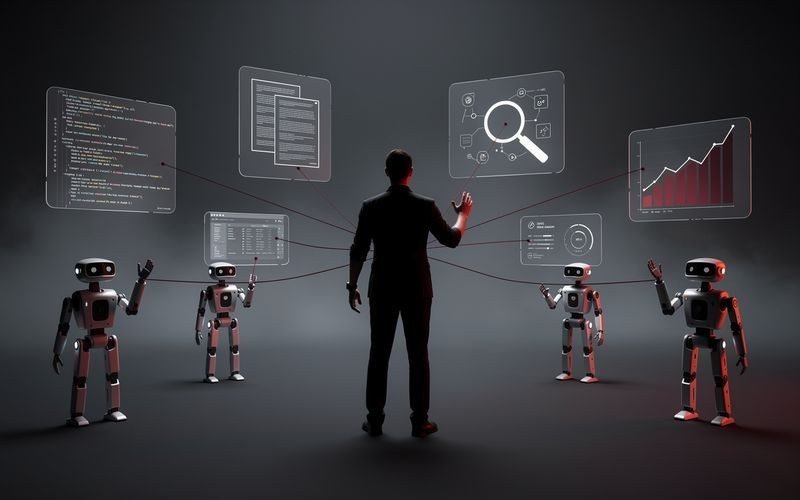
Claude Code, Codex, Gemini, Antigravity and OpenCode on one wall. Agents work through your backlog, sessions pass the baton day and night, accounts rotate before they run dry, and nothing about your work is sent to us.
Open the consoleWaiting for you 2
Running 3
Today
03 The console
This is the screen you work in.Take it apart.
The real Agent Farm Console, rebuilt. Scroll and it assembles: the leg of the chain, who is waiting for you, a session that rebuilt the extension and kept talking, the context meter and the quota shield.
AGENT FARM
⌄ AGENTS
⌄ TASKS
› MISSIONS
⌄ TOOLBOX
⌄ LIVE FEED
Console
developer · working
04 The whole farm
You have seen the screens. Here is the whole farm.
Every tile is something Agent Farm does today, 92 of them in ten districts. Code is only one part: the same farm cuts videos, writes up a thesis chapter and keeps a weekly channel going. Watch one event travel through the farm, or click any tile.
Never stops
7Work keeps going through full contexts, full accounts and its own updates.
Any project
7One backlog per project, and the project can be anything.
Beyond code
13Agents work as a production team and hand you finished media.
Recipes and triggers
10Work that starts on time, on an event, or from one sentence.
Works as a team
9Agents on different engines plan, split and check each other.
Never forgets
9Every session is kept, and what matters becomes a wiki.
Any brain
10Five engines, and through routes, almost any model.
Just ask
10You never have to learn the farm. Tell an agent, it sets it up.
Measured, not claimed
9What every step cost, how much plan is left, and whether the work was good, in numbers.
Safe and yours alone
8Guards stop what an agent should not do, and nothing about your work comes to us.
Under the tiles
- 92
- things it does
- 602
- commands
- 243
- settings
- 579
- bridge operations
- 5
- engines
- 1,053
- releases

Fri 18:00
You leave the desk.
Thirty-eight items are open on the backlog. The fleet takes it from here.
Chapter I of X7 things
Never stops
Work keeps going through full contexts, full accounts and its own updates.
05 Day and night
chn_7f3a · demo data shaped like the real chain
Ninety-two legs. Three days, four nights. Straight off the backlog.
Every block is one fresh session, coloured by the account it ran on. The band above it is the backlog item it was given: when an item closes, the next session opens on the next one in your queue. Night or day makes no difference to it. A hatched gap is the chain waiting for a quota reset, then waking by itself. Hover a block to read it.
06 Why a farm
Not a chat window. A place to grow.
Agents are raised here. Fitted to you.
You lead · they learn youA chat forgets you when it closes. An agent on the farm has a home of its own, and everything it does there stays. It notices the corrections you keep making, a judge scores its work, and week by week it works more the way you would.
- A home of its own. Identity, rules, duties, tools and a memory that grows with every job, on your disk.
- It learns you. The corrections you repeat come back as rules for it to keep, once you say yes.
- One agent or a fleet. Direct one with precision, or a whole fleet with the same tools.
Rules learned from you
- None yet. It reads your project and its instructions first.
- ✓Writes commit messages the way you do
- ✓Runs the tests before every push
- ✓Leaves your morning note by 08:00
- ✓Keeps Monday's quota for the release
- ✓Asks before it touches the billing code

Sat 03:12
The farm is still at it.
Leg after leg, account after account. Nobody has to stay awake for it.
07 The rules of the relay
Real defaults · every one is a setting
Runs without you. Braked so it never runs away.
Every number below is a setting you can change. These are the defaults the extension ships with.
Converge
The session is told once to start nothing new and finish the step in flight.
contextConvergePctHand over
It stops, commits, writes its handover note and ends the run. The next leg opens with that note.
contextHandoverPctQuota handover
When its account's five-hour window is this full, the leg hands over and the next one opens on another account.
quotaHandoverPctWeekly line
The same handover for the weekly window, so a chain never runs an account into the wall.
quotaWeeklyHandoverPctWait for the reset
Every account past the wall? The next leg parks until the first reset, then wakes and carries on.
parked until 02:15Barren-chain brake
Two legs in a row that end on the same commit stop the chain, instead of burning quota on nothing.
batonMaxHopsEmergency leg
A leg cut off by an error or left with uncommitted work gets a successor that is told what it left.
batonEmergencyTemplateNo ceiling
Chains are capped at 6 legs by default. Set it to 0 and the relay runs until the work is done.
batonMaxHops: 0
Any project
It starts as a line in a notebook.
Write the thought down. Agents work the list off in the order you set, whether it is an app, a film or a thesis.
Chapter II of X7 things
Any project
One backlog per project, and the project can be anything.
08 Backlog
Projects of any kind · the work list · the track
You write the work down. The fleet works it off.
An app, a documentary, a thesis, a campaign: every project has its own page, and the work waits in one plain Backlog.md file. You put it in order; agents take the top of it, item by item, and tick off what they finish. The Track tab remembers how each one was done.
Agent Farm
1463 sessions · the relay chain is on itThis extension, built by its own agents.
Capture
- One line is enough. No code, no form. Ctrl+Alt+B takes a thought from anywhere in VS Code, and it is filed later, by you or by an agent sweeping.
- The order is yours. Drag the queue. "Do the top five" means your top five, and anything waiting on an unfinished item is held back, with the reason shown.
- Every session starts with what's next. The top of the queue rides in each session's brief, so a chain moves on to the next item with no paste and no lookup.
- Big work comes in families. A whole and its parts, sized XS to XL. Below, one chain works through twelve parts, day and night.
- Agents say what they wrote.
#byAIis something an agent noticed and filed itself: a proposal.#byREQis your thought, typed by an agent. - A plain file with a memory. Backlog.md opens in Obsidian and travels in git. The Track tab keeps which session, and which turn of it, worked each item, and what an agent tried that did not work, so the next one starts from there.

Beyond code
Not all work is code.
Agents work as a production team, from the idea to the cut, and you get the film, not a chat about it.
Chapter III of X13 things
Beyond code
Agents work as a production team and hand you finished media.
09 Studio
A production · scene by scene · demo
Not only code. A film, made by agents.
Give the Studio a brief. Agents write the shots and a video model makes them. A vision model checks each one against your criteria, and a shot that fails is made again with the critique. You keep or drop; Premiere gets the sequence.
🎬 Studio
The last keeper · 3/6 scenes approved · $1.62 in 30 daysthe production, scene by scene
The sequence Premiere would get, playing. A demo film drawn on this page, frame by frame; in the app each shot comes from the model its step names, here a video model for every scene.
Chapter IV of X10 things
Recipes and triggers
Work that starts on time, on an event, or from one sentence.
10 Recipes and triggers
Tasks · schedules · triggers · workflows
Work that starts by itself.
On a clock, when a file lands, or from one sentence in plain words. Switch Gatekeeper on and, before any model is woken, Jev, a model that never chats and only decides, says whether there is real work. Noise wakes nobody.
Tasks
plan what runs · see what ran — updated 03:12Waiting for a firing.
- 1Extract the soundtool · ffmpeg
- 2Transcriptmedia · whisper
- 3Pick the momentsagent · editor
- 4Cut the shortstool · ffmpeg, one per moment
- 5Final checkcheckpoint
Gatekeeper is off by default. Here it is on, so you can watch it say no.

Works as a team
Agents work like a team. You still lead it.
A lead plans, a team on different engines does the work, and one word from you changes its course.
Chapter V of X9 things
Works as a team
Agents on different engines plan, split and check each other.
11 Together
Missions · four engines, one team
A lead, a team, an honest verdict.
Give a mission to a lead. It plans round by round, hands tasks to agents on different engines, reads what comes back, and ends by saying how it really went. Partial is an answer too.
CSV and JSON lines export and pass their tests. The Windows path was never run, so the mission says partial, not done.
Missions
Dynamic orchestration: a lead agent plans round by round, delegates to the team, and finishes with an honest verdict.
A campaign takes the next item off a project backlog, opens a clean unattended session on it as an ordinary task row, and when that row ends it reads what the session left behind and opens the next one — until you stop it.
| Mission | Lead + team | Status | Rounds | Tasks | Tokens | Cost | Started |
|---|---|---|---|---|---|---|---|
| ›Timeline export, end to endADPT | manager +3 | running | R3/8 | 7 | 412.6k | $0.62 (mixed) | Oct 11, 09:12 |
| ›Q3 earnings, ten companies compared | manager +2 | done | R4/6 | 6 | 301.2k | $0.48 (mixed) | Oct 10, 16:40 |
| ›Do two agents really argue?ADPT | reviewer +1 | donepartial | R2/5 | 1 | 72.3k | $0.10 | Oct 9, 17:53 |
| ›A chaired council that really arguesADPT | manager +0 | cancelled | R1/8 | 3 | 58.9k | $0.11 (mixed) | Oct 9, 21:17 |
Chapter VI of X9 things
Never forgets
Every session is kept, and what matters becomes a wiki.
12 Memory
Sessions · wiki · Obsidian · memory
Every session kept. What mattered becomes a wiki.
Every conversation on this machine is kept, from every engine, with what it cost. Mark the turn that mattered; nothing is written yet. Later one run reads the marked turns and writes wiki pages into your Obsidian vault, one concept to a page, each with its sources.
You curate, agents write. Pages are plain Markdown in your own vault; the links between them are what Obsidian draws as a graph.
Chapter VII of X10 things
Any brain
Five engines, and through routes, almost any model.
13 Brains
Engines · routes · sign-ins · keys
Five engines. Any number of brains.
Claude Code, Codex, Gemini, Antigravity and OpenCode, each paid for the way you already pay. Claude Code and OpenCode can also run other models through a route: a provider's, a free one, or one at an address on your own machine. Keys stay in your OS keychain.
A plan, a key or an app sign-in is each engine's own. A route is one address, one key and its models, lent to Claude Code or OpenCode when a session starts; it is never written into their files.
Chapter VIII of X10 things
Just ask
You never have to learn the farm. Tell an agent, it sets it up.
14 Just ask
The bridge · one shell command · 579 operations
You never have to learn any of this. Just ask.
Every session is told at its start how to reach the farm. So you say it in one sentence and the agent does it: it reads what the farm can do, then calls it, one command at a time. Each call shows up as a notification. Nothing is done behind your back.
Agent Farm bridge: run node "…/bridge/af.js" <op> [@args.json] from the shell — it is not an MCP tool, and every engine and account reaches it the same way.

Mon 08:00
Coffee, and the weekend's work.
On your phone: nine items closed, two waiting for you. One tap answers each.
15 Never waits
Question cards · phone · Telegram · sound · voice
Away from the desk. Never in the way.
An agent with a question doesn't sit idle for hours. A countdown runs, and when it ends the recommended answer goes in. Permissions are different: they wait for you, ring, and reach your phone or a Telegram chat, where one tap answers. Every event has its own sound, and any answer can be read aloud.
Which export format should the timeline use?
Nobody at the desk? When the ring runs out, the recommended option goes in.
Run git push origin main?
A tool permission is never answered for you. It waits, rings, and reaches your phone.
Now
2 waiting · 3 running · $41.20 today
Waiting for you 2 ›
Running 3 ›
Today
The farm on your phone, in three tabs: Now, Web and Devices.
Every session can sound like the rest (Like all), ring even when the fleet is quiet (Always), or never make a sound (Silent). It can take its own tones and its own voice, and have every answer read aloud as its turn ends. The Agents tab does the same for all of one agent's sessions.
Voice
Reading a message's 🔊, Read Last Answer, Read Selection, Read aloud and the daily briefing
Press 🔊 to hear the whole answer, or select a few words and press Read selection. Code is said by its size, not read out character by character.
In the app the voice is your system's own, local and free: Windows speech, macOS say, Linux spd-say. A Turkish answer is read by a Turkish voice and an English one by an English voice. Here your browser reads it, with a voice on this device only, so the text goes nowhere.
Chapter IX of X9 things
Measured, not claimed
What every step cost, how much plan is left, and whether the work was good, in numbers.
16 Measured
Cost · plan · quality
Every cent counted. Every check scored.
Agents always sound sure. The farm does not take their word for it: it reads what each step cost from the transcripts, keeps every account's window in view, and has the work judged against its criteria by the cheapest model that can tell.
Planevery account · live
Where it wentthe live leg · from its transcript
- ◈thinking0
- ▸reply0
- ⌘local tool0
- ↩tool result0
- ⇄MCP tool0
- ⌗web0
- ⑂sub-agent0
- ⚙harness0
- ·local only0
◈ thinking: billed as output, the dearest token there is.
- ⚑ editor is at 4.5× its normal today: $4.10 against a $0.92 median
- $0.00 OpenCode on a free model: a real zero
- tok Codex on a ChatGPT plan: tokens, and why there is no price; never one made up
Judge laddera step's check · cheap first
Evals · after a model change
Chapter X of X8 things
Safe and yours alone
Guards stop what an agent should not do, and nothing about your work comes to us.
17 Local
0 bytes
of your work to us. Ever.
- Free: nothing to us at all. No account with us, no request to a server of ours. It runs inside VS Code and reads each CLI's own files on disk.
- A paid licence: one check, once a day. The whole message is beside this. If it cannot reach us, it keeps working for 30 days.
- No telemetry, no analytics. We don't know which features you use, how often, or on what.
- Secrets stay in the OS keychain. An account is a config folder, not a copied credential.
- Live hooks listen on 127.0.0.1 only. The phone page is yours to switch on, on your own network.
The licence check, wholepaid licence · once a day
→ { "key": "AF-7Q2K-…-M4XD", "device": "a91f…e07b", "version": "3.931.0-beta" } ← { "valid": true, "until": "2026-11-12" }
Never in it: your code · prompts and answers · transcripts · file, folder and project names · account names · costs and tokens · which features you use, or how often.
Built like infrastructure.
Every number stated on this page comes from a real screen of the app or from its source. The moving parts are demos, with demo data.
18 Start
Straight answers
What it does, and where it stops.
The limits are stated, not hidden. They follow from what the engines themselves offer.
Where does the work come from?
From each project's backlog: a plain Backlog.md you write and put in order. Every session starts with the top of the queue in its brief, agents tick off what they finish, and anything waiting on an unfinished item is held back.
Which engines does it run?
Claude Code, Codex, Gemini, Antigravity and OpenCode. A session, a task, a schedule, a workflow step or a mission delegation can run on any of them, and Agent Farm reads each CLI's own history on disk.
Is the cost figure a real bill?
Only Claude Code and OpenCode publish a price per turn. For the others a cost is derived from your pricing rules: good for comparing runs, not a bill. $0.00 is never printed where no price exists.
Does every engine show up live, mid-turn?
Claude Code and Codex report each step through their own hooks, and Agent Farm's hook relay forwards Gemini's, so their sessions reach the Live Timeline mid-turn. Antigravity and OpenCode have no hooks: Agent Farm follows the sessions it hosts for them. Only Claude Code can be told something back through a hook, so the context and quota lines reach its sessions; on the other engines a line that could not be said is recorded as undelivered.
What happens when every account is out of quota?
A leg hands over at 90% of its five-hour window and the next one opens on the emptiest account. When none is left, the chain parks until the first reset, then wakes and carries on.
Can a chain run away?
Chains stop after 6 legs by default. Set the limit to 0 for no ceiling. Two legs in a row that end on the same commit stop the chain either way.
Does anything leave my machine?
Nothing about your work comes to us. Free, Agent Farm never contacts us. A paid licence checks itself once a day: the key, a hash of the machine and the version, nothing else, and without a connection it keeps working for 30 days. There is no telemetry. Your engines talk to their own providers, exactly as they do without Agent Farm, and anything else it reaches is a service you switched on yourself.
Agent Farm for VS Code
Fill the backlog. The fleet works it off, day and night.
Claude Code · Codex · Gemini · Antigravity · OpenCode · runs on your machine